 Return to blog

Key Highlights
- Misusing terms like carbon neutrality, net-zero, and offsetting can increase greenwashing risk and regulatory scrutiny.
- Clear, transparent climate disclosures and accurate terminology are essential to maintain credibility and reduce legal risk
Much about corporate sustainability is in flux right now, but nothing changes the need for businesses to make bold change through concrete steps to address their climate impacts. But when climate claims and commitments are inaccurate, indefensible, or poorly communicated, they erode stakeholders’ ability to rely on companies’ information and can create problems for the company.
Here, we discuss some of the most misunderstood terms in corporate climate communications, and provide insights into how companies can avoid greenwashing, reduce risk, and – most importantly – make sure their commitments have an impact.
Growth of Greenwashing
Stakeholders in the world of corporate climate action have good reason for skepticism. Companies have used terms like “offsetting,” “net-zero,” and “carbon neutral” in inconsistent ways, leaving uncertainty that any action to reduce greenhouse gas emissions is actually taking place.
Relatedly, climate-related claims are facing increased scrutiny by regulators, investors, and the public.
A 2026 Greenwashing Litigation Trends Update from Ropes and Gray highlighted the growing trend of “heightened scrutiny over sustainability representations and recyclability claims across multiple industries” in the US. Legal actions by state and local jurisdictions, as well as by private entities, continue to challenge companies’ climate-related claims.
Misstating climate progress, intentionally or not, can expose organizations to greenwashing allegations, shareholder challenges, and regulatory risk. It is more vital than ever for companies to invest time and attention in ensuring their climate ambitions are grounded in sound data and discussed in transparent, realistic terms.
Carbon Credits and Carbon Offsets: What They Actually Do
One carbon credit represents one metric ton of carbon dioxide equivalent (CO₂e) that has been reduced, avoided, or removed from the atmosphere by financing a specific project, such as reforestation, or using technologies to capture methane. Companies can purchase carbon credits to support carbon-neutrality claims (see below); however, purchasing credits does not directly reduce GHG emissions in their own operations or value chain.
Purchasing carbon credits does not directly reduce a company’s own emissions. It finances emissions reductions or removals elsewhere.
Carbon credits can be an effective tool for helping companies reach carbon neutrality after their GHG emissions have been reduced to the greatest extent possible – but there is an inherent risk to their use. In recent years, the credibility and transparency of carbon credits have been called into question as many of the projects underlying credits have failed to deliver measurable, permanent emissions reductions. It is critical that companies who wish to use carbon credits work with widely validated and trusted organizations such as Gold Standard to ensure that the credit is delivering the promised results.
Offsetting describes the action of using those credits to neutralize an organization’s emissions. In other words, to claim that 100 metric tons of CO₂e have been “offset,” an organization would need to purchase 100 carbon credits and retire them (effectively removing them from the carbon market). This ensures that the climate projects underlying the credits are not double-counted and achieve the intended emissions-reduction impact.
Offsetting can play a role in an organization’s broader climate strategy, particularly in addressing emissions that are operationally unfeasible to reduce further. However, they are not a substitute for decarbonizing a company’s operations or value chain emissions, and treating them like direct reductions is a risky, common misstep.
G&A’s recommendation: Offset stubborn emissions but be transparent about 1) why remaining emissions cannot be further reduced and 2) the qualities of the underlying carbon credits.
Carbon Neutral: An Accounting Outcome, Not a Decarbonization Strategy
A carbon neutral claim indicates that an organization has achieved a balance between its GHG emissions and reductions. This claim typically encompasses Scope 1 and Scope 2 emissions, and occasionally Scope 3 emissions. To achieve carbon neutrality, companies frequently pursue a combination of emissions reductions and the procurement of carbon credits, which are used to offset reduce remaining emissions. On paper, this can look like the company’s net emissions are zero.
However, it’s important to note that achieving carbon neutrality does not necessarily imply significant reductions in emissions. A company may continue to produce the same level of emissions or even increase them while still claiming carbon neutrality, provided it buys enough carbon credits to offset its impact.
The credibility and impact of a carbon neutral claim largely hinges on the quality of the carbon credits purchased. As mentioned previously, carbon credits have increasingly come under greater scrutiny, particularly regarding the effectiveness and integrity of the offset projects involved. Some of the aspects of credits most disputed are:
- Additionality: Would the emissions reduction have occurred without purchase of credits?
- Permanence: Will the benefits of the emissions reduction last, or is there a possibility that they could be reversed?
- Verification: Has the carbon credit project been independently validated?
If the answers to these questions are unclear, the claimed climate benefits – and the validity of the carbon neutrality claim itself – may be overstated. Resources such as A Buyer’s Guide to Natural Climate Solutions Carbon Credits from the World Business Council for Sustainable Development can help companies looking to understand and navigate the complexities of carbon credit purchasing.
G&A recommendation: Avoid conflating carbon neutrality with net-zero in statements about your climate strategy and reporting.
Net-Zero: A Fundamentally Higher Bar
Net-zero commitments, particularly those aligned with the Science Based Targets initiative (SBTi), reflect a far more rigorous standard. The SBTi net-zero framework includes four elements of a corporate net-zero target:
- Near-term target: 5- to 10-year GHG mitigation target aligned with 1.5°C pathways
- Long-term target: 90% reduction in emissions by 2050 or sooner, aligned with 1.5°C pathways
- Neutralize only the small remainder of residual emissions remaining after reduction efforts (typically less than 10%)
- Beyond value chain mitigation
Net-zero is not achieved through offsetting business-as-usual emissions. It requires deep, sustained decarbonization across operations and the value chain.
A “net-zero by 2050” commitment validated under SBTi standards is materially different and far more rigorous than a “carbon neutral by 2030” claim achieved primarily through credit purchases. Both may sound ambitious at first glance, but committing to net-zero by 2050 entails reducing absolute emissions, which often requires lasting changes in how a business operates.
G&A recommendation: Ensure your organization is aligned on net-zero requirements and committed to operational change. Carbon neutrality may be best framed as a stepping stone – not endpoint – of your climate ambition.

Reducing Greenwashing Risk Through Accurate Claims
For companies pursuing ambitious climate strategies, using precise language is one of the most effective ways to reduce risk. Sustainability, legal, and leadership teams can ensure accurate, defensible, and transparent claims by:
- Avoiding conflating carbon neutrality with net-zero in public statements
- Clearly outlining the role of offsets versus direct emissions reductions in your climate strategy
- Applying strict quality criteria to any carbon credits used
- Transparently disclosing which emissions scopes are accounted for and the reasoning for any exclusions
How a company talks about climate action ensures alignment between its climate initiatives and its public positioning. Clear, accurate climate claims support credibility with investors, regulators, and other stakeholders, while positioning organizations to adapt as standards continue to evolve.
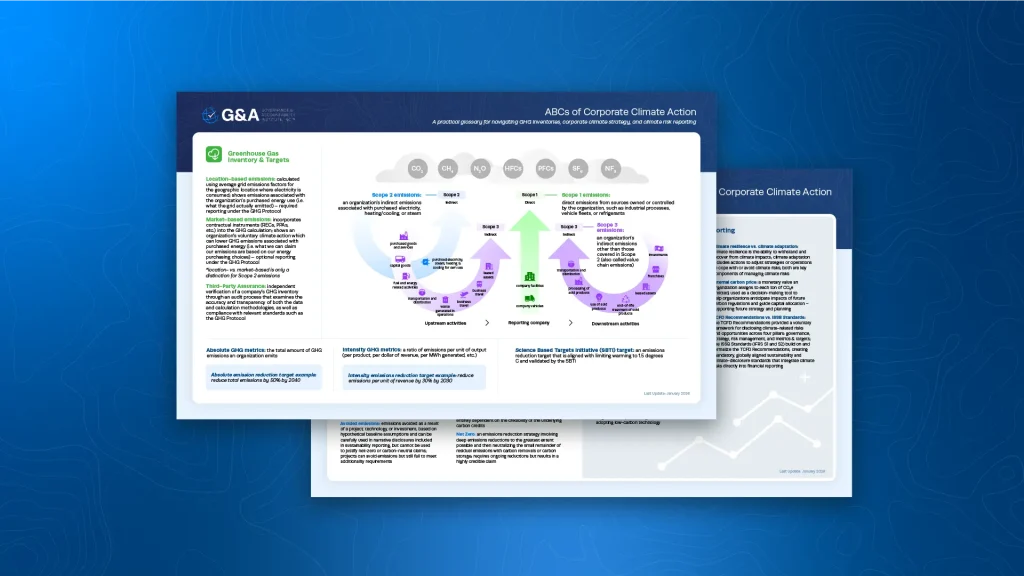
Download G&A’s ABCs of Corporate Climate Action for clear, defensible definitions

Build your sustainability strategy.
Founded in 2006, Governance & Accountability Institute (G&A) is a New York–based sustainability consulting and research firm advising corporate leaders and investors at the intersection of strategy, governance, and regulation. For two decades, we have partnered with executive teams and boards to translate sustainability strategy into durable enterprise value — helping organizations navigate shifting market expectations, evolving policy landscapes, and increasing capital markets scrutiny. Set up a call to learn more about how we can help your company.



Share This Article

 How Can G&A Help?
Build your sustainability strategy.
Chat with our experts to get started on your journey.
Get Started
