 Return to blog
Key Highlights
- The EU's Carbon Border Adjustment Mechanism (CBAM) places a carbon cost on imported goods in six high-emissions sectors — cement, iron and steel, aluminum, fertilizers, electricity, and hydrogen.
- U.S. exporters face no direct legal obligation, but EU buyers will likely require emissions data from suppliers.
- Companies using actual emissions data instead of default values may significantly reduce their CBAM costs, since defaults are based on the ten highest-emitting exporting countries.
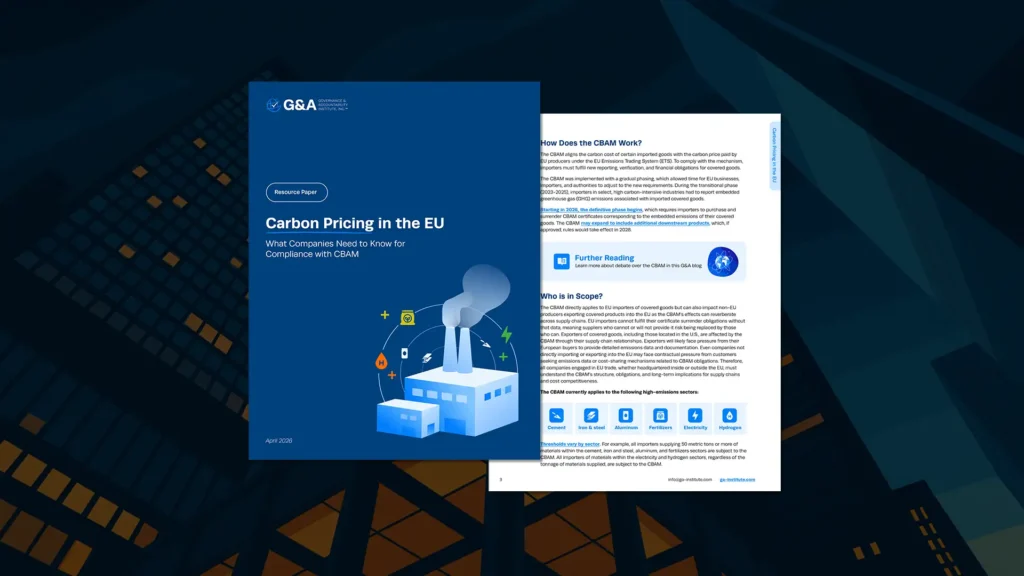
G&A just released a resource paper on an EU regulation aimed at mitigating climate change in a fair way for domestic businesses. This policy – the Carbon Border Adjustment Mechanism (CBAM) – currently affects EU companies in high-emissions manufacturing sectors, as well as those in their supply chains.
To explain this new mechanism, we asked Neva Modic, G&A Sustainability Analyst and author of the resource paper, to address some questions we’ve been receiving from our clients.
What is the CBAM?
The Carbon Border Adjustment Mechanism (CBAM) is an EU policy that places a carbon cost on certain goods imported into the EU. The fee mirrors the carbon price already paid by European producers. To comply with the CBAM, companies will purchase certificates corresponding to the amount of emissions embedded in their imported products.
Why was the CBAM needed?
Carbon pricing is a strategy for incentivizing lower emissions in production processes.
The CBAM was designed to avoid “carbon leakage,” which occurs when importers purchase goods from countries with less stringent climate rules – meaning the goods may be more emissions-intensive – and importing them into the EU at a lower cost than if they were produced domestically. This has disadvantaged domestic producers who must comply with stricter emissions regulations, and it has an added effect of shifting to other countries the carbon pollution associated with EU consumers’ purchases .
Although the CBAM is an important step for climate change mitigation, it has economic impacts on several manufacturing-dependent developing countries, who have opposed the policy.
Which industries and goods does the CBAM cover?
CBAM currently applies to six high-emissions sectors. For four of those sectors, it only applies when the importer reaches a threshold for volume of goods.
| Sector | Threshold of import volume |
| Cement | 50 metric tons |
| Iron and steel | 50 metric tons |
| Aluminum | 50 metric tons |
| Fertilizers | 50 metric tons |
| Electricity | No threshold – all importers covered |
| Hydrogen | No threshold – all importers covered |
CBAM is not brand-new, so what changed on January 1, 2026?
The CBAM was phased in gradually to give businesses, importers, and authorities time to adjust to new requirements. A “transitional period” took place from 2023-2025, during which companies were required to report quarterly on the emissions embedded in their imports, but no fee was associated with the emissions. At the beginning of 2026, the “definitive phase” of CBAM began.
Key changes as of January 1, 2026 include:
- Companies must now surrender CBAM certificates corresponding to the amount of embedded emissions in their imported products
- The EU’s own calculation methodology for direct emissions is mandatory
- Third-party verification of emissions data is now required
- Reporting has shifted from quarterly to annual, with the first declaration due in September 2027
What exactly do companies have to report?
In their annual CBAM declaration, companies must report the type and quantity of covered goods, the direct and indirect embedded greenhouse gas (GHG) emissions tied to those goods, details about the country of origin and production facility, the manufacturing processes used, information on precursor materials, and any carbon price already paid in the country of origin. The calculations in this declaration inform the amount of carbon certificates the company must purchase.
How do CBAM certificates work, and what do they cost?
Companies must purchase a CBAM certificate for each metric ton of CO₂ emissions associated with their covered imported goods, as reported in their annual CBAM declaration. Certificates are purchased from the National CBAM Competent Authority (NCA) in the EU member state where the importer is established.
Their price is linked to the EU Emissions Trading System (ETS) auction price and is calculated as a quarterly average in 2026, moving to a weekly average from 2027 onward.
As decided through the EU’s Omnibus simplification package relating to corporate sustainability reporting, certificate sales will begin on February 1, 2027, at which point companies can begin purchasing certificates corresponding to their emissions. The first verified annual CBAM declaration for 2026 is due September 30, 2027.
My U.S.-based company exports into the EU. How are we affected by CBAM?
As a U.S. exporter, CBAM does not create a direct legal obligation; the formal compliance burden falls on the EU-based importer. However, because EU importers must purchase CBAM certificates based on the embedded emissions of their supplied goods, they likely will ask for emissions data from exporting companies. If the exporter cannot supply that data, EU buyers may shift toward suppliers who can provide it.
My goods were already taxed under another country’s carbon pricing system. Do I still owe the full CBAM fee?
Not necessarily. The CBAM includes a deduction mechanism to prevent double taxation. If a carbon price was already paid in the country where the goods were produced, importers can deduct that amount from the CBAM certificates they’re required to surrender. This is why the annual declaration requires documentation of any carbon costs paid at origin.
What are default values? Why should I invest in actual emissions data?
Default values are pre-determined carbon intensity figures permitted when real supplier data isn’t available. The downside of default values is that they’re based on the average emissions intensity of the ten highest-emitting exporting countries. Therefore, if your suppliers run cleaner-than-average facilities, using defaults would inflate your CBAM costs, whereas investing in actual emissions data would likely result in lower costs.
What’s the difference between the calculation-based and measurement-based approaches?
The calculation-based approach to measuring emissions is based on quantities of fuels and materials consumed, as well as respective emission factors. The measurement-based approach, on the other hand, is based on continuous monitoring of greenhouse gas concentrations and flue gas flow rates at each emission point. The calculation-based approach is more commonly used, whereas the measurement-based approach is typically only used where Continuous Emissions Monitoring Systems (CEMS) are already in place.
What are the penalties for non-compliance and how are they enforced?
CBAM enforcement is embedded in the EU’s customs declaration system and monitored continuously by National CBAM Competent Authorities through the CBAM Registry.
Financial penalties for non-compliance typically range from €10 to €50 per unreported metric ton of CO₂, and authorities can also require retroactive certificate surrender, revised reporting, or in serious cases, restrict access to the EU market entirely.

How can G&A help?
G&A can support companies in understanding their CBAM obligations. Set up a call with us today to learn how we can help your company navigate CBAM compliance, reduce carbon costs, and gain competitive advantage in EU trade.



Share This Article

 How Can G&A Help?
Build your sustainability strategy.
Chat with our experts to get started on your journey.
Get Started
