 Return to blog

Key Highlights
- COP30 outcomes continue to evolve post-summit, with key developments emerging in carbon markets, finance, and reporting standards
- The EU’s Carbon Border Adjustment Mechanism (CBAM) introduces new costs and competitive dynamics for carbon-intensive imports
- A new global push for carbon markets and climate finance is accelerating, with private sector participation critical to progress
- Alignment between GHG Protocol and ISO standards signals a move toward more consistent global carbon accounting frameworks
It has been four months since the 30th annual Conference of the Parties to the UN Framework Convention on Climate Change (COP30) wrapped up in Belém, Brazil. Quickly considered a mixed bag of successes and disappointments, the summit outcomes were criticized for a lack of progress on notable issues. But COPs are complex structures, and results can emerge in the months that follow, despite disappointments with government negotiations. Businesses aiming to keep up with climate-related risks and opportunities should watch for these in the coming months.
Partial CBAM sets the stage
In a notable development for companies operating in Europe, the European Union announced plans to introduce a border tax on certain products with carbon-intensive production like steel, fertilizer, cement, and aluminum. This tax, known as CBAM – carbon border adjustment mechanism – aims to make pollution more expensive by discouraging producers from sourcing carbon-intensive materials from areas outside the EU, where rules may allow for more carbon-intensive production methods and energy generation.
The tax has drawn criticism from countries that export these items into the EU, such as India, which relies on coal-fired energy for manufacturing products for export. These countries have voiced that they find the measure unfair, as it will make their items more expensive in Europe, and therefore less competitive.
The first phase of the CBAM went into effect on January 1, 2026. There are additional proposals to expand the CBAM to include additional finished and semi-finished products. If approved, the additional rules would take effect in 2028.
What it means for companies now: Businesses operating in Europe should anticipate higher costs going forward if they plan to import any of these carbon-intensive items. Businesses outside of Europe exporting these items to the EU should anticipate increased competition. G&A recently released new resources exploring the mechanics and implementations of this ground-breaking mechanism.
EDF fills guidance gap for private finance
COP 30 made some progress on the previously established Baku to Belém Roadmap, which aims to mobilize $1.3 trillion for developing countries by 2035 to enable them to adapt to climate change and mitigate their emissions. The document outlining this roadmap encourages governments, financial institutions, and others to begin formulating goals and plans to increase climate funding for developing nations.
What some find missing from the road map is adequate guidance on specific, actionable actions for the private sector, specifically, despite heavy reliance on private investment to reach the target. The Environmental Defense Fund has laid out a series of recommendations to begin supporting the Baku to Belém Roadmap. Within this series are recommendations for specific sectors, including forests, agriculture, oil and gas methane abatement, and global shipping. Each sector has short and long-term actions to reach the goals of the roadmap.
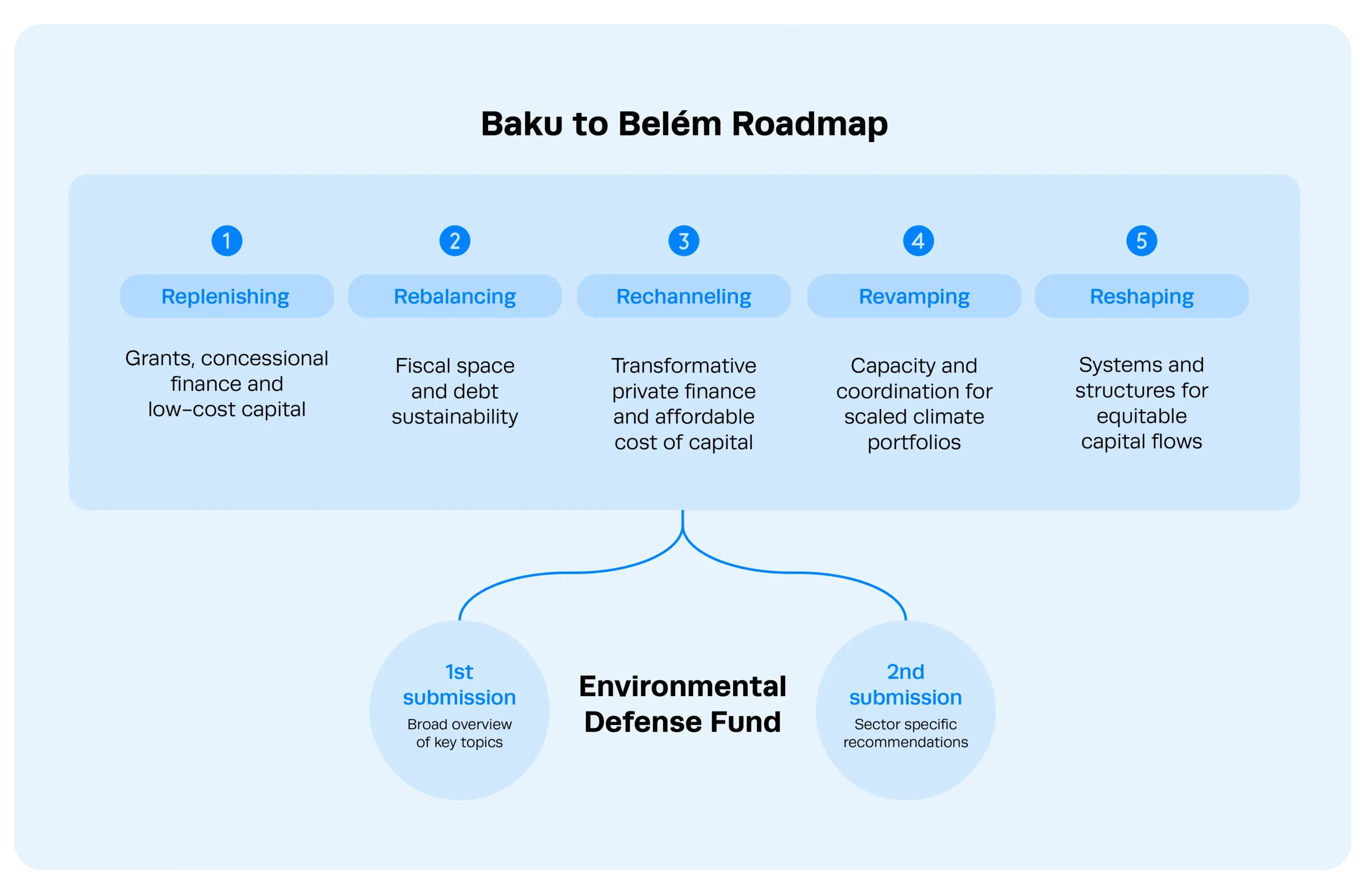
The series also discusses key issues pertaining to the roadmap, such as addressing the high cost of capital in energy markets. It reviews best practices and real-world examples of ways in which organizations have addressed parts of the roadmap, including current and ongoing initiatives. Companies that hold a stake in any of the listed sectors may benefit from considering the areas of improvement that the series identifies, and ways to integrate business plans with the outlined goals and current initiatives.
What it means for companies now: Private institutions in a position to develop climate financing mechanisms for developing countries have an opportunity to shape the process and support the achievement of the target by 2035 or sooner. They can begin by reviewing the recommendations from the EDF.
Wide coalition takes up global carbon market
Brazil’s gatherings launched the Open Coalition on Compliance Carbon Markets with the support of 17 countries and the EU to establish a global standard. The collaboration aims to create a unified approach to forming a global carbon market. This was a notable development coming off the heels of COP 30, as many were disappointed that the Belém talks made minimal progress in operationalizing a global carbon market.
COP talks did make some advancement on articles 6.2 and 6.4 from the Paris Agreement. Article 6.2 provides accounting and reporting guidance for Parties, while Article 6.4 establishes a UNFCCC mechanism that can be used to trade high-quality carbon credits. But there is not yet a standard global carbon market.
What it means for companies now: Organizations in the private sector can expect major strides in the coming years towards its development.
For businesses that want to get involved with its development or that want to stay ahead of the curve, they can start by looking into the Open Coalition on Compliance Carbon Markets and reviewing the new updates to Article 6 of the Paris Agreement. For more information about the Open Coalition on Compliance Carbon Markets, check out our blog post “What Emerged from Brazil? New Global Coalition Aims to Shape Carbon Cap & Trade.”
GHG Protocol aligns with ISO
Following COP30, the GHG Protocol and ISO released a detailed COP30 Action Plan to Accelerate Solutions (PaS), intended to support the COP30 Presidency’s mission to deliver accelerated quantified emissions reductions by 2030. The plan helps align GHG Protocol and ISO frameworks to create consistent global carbon accounting standards. For companies looking to get a clearer picture of what the future of global carbon accounting may look like, or any organization involved in measuring carbon emissions along their value chain, this is a beneficial resource to review.
What this means for companies now: Businesses should stay on the lookout for continued developments in reporting standards and look forward to continued consolidation and alignment between standards. They can start preparing and understanding these changing frameworks by reviewing the GHG Protocol and ISO’s COP30 Action Plan to Accelerate Solutions (PaS).
Looking towards COP 31
The annual COP creates a high-profile platform for exploring critical ideas related to climate change mitigation and adaptation. But enacting them takes place through incremental steps underway all year long between the in-person meetings.
The world is already looking ahead towards the next summit, with Australia and Turkey set to co-host in November 2026, and resources currently emerging to support private sector engagement.
Companies can prepare for COP31 now by taking action on the COP30 developments and associated resources relevant to their practices.

Build your sustainability strategy.
Founded in 2006, Governance & Accountability Institute (G&A) is a New York–based sustainability consulting and research firm advising corporate leaders and investors at the intersection of strategy, governance, and regulation. For two decades, we have partnered with executive teams and boards to translate sustainability strategy into durable enterprise value — helping organizations navigate shifting market expectations, evolving policy landscapes, and increasing capital markets scrutiny. Set up a call to learn more about how we can help your company.



Share This Article

 How Can G&A Help?
Build your sustainability strategy.
Chat with our experts to get started on your journey.
Get Started
