


This website uses cookies so that we can provide you with the best user experience possible. Cookie information is stored in your browser and performs functions such as recognising you when you return to our website and helping our team to understand which sections of the website you find most interesting and useful.
Managing Value Chain Data Requests with the VSME
Posted on March 25, 2026 by Christina Carlton
#Corporate CSR Reporting #Corporate Sustainability #Corporate Sustainability Reporting #European Green Deal #Sustainability Reporting
Part of the Omnibus I Package was an intent to reduce the sustainability reporting burden on smaller companies. And in regulatory terms, it largely delivered: small and medium sized entities (SMEs) are no longer within the mandatory scope of the EU’s Corporate Sustainability Reporting Directive (CSRD). Additionally, the revised CSRD refers to “protected undertakings,” establishing the principle that disclosure requests should be proportional to the company’s size and presumed capacity to prepare sustainability disclosures. The protected undertakings principle effectively constrains what large companies can reasonably ask of their smaller value chain partners. On paper, pressure on both large companies and SMEs has been relieved.
In practice, a new challenge is emerging.
The Challenge: Fragmented Data Requests for SMEs
Large companies subject to CSRD still require sustainability data from their value chains to fulfill reporting requirements. Investors, lenders, and customers continue to request this information as well. With SMEs now out of scope for the CSRD, there is less regulatory pressure to standardize SME disclosures. One result is that the market is seeing a rise in customized questionnaires – each company develops its own set of questions to meet specific reporting needs, which often results in multiple requests being sent to the same SME teams. Instead of reducing the burden, this shift may actually increase fragmentation and complexity for SMEs.
This is precisely the problem the Voluntary Standard for SMEs (VSME) was built to solve.
Developed by EFRAG and endorsed by the European Commission, the VSME provides large CSRD reporters with an EU-endorsed reference for reasonable value chain data requests. This helps coordinate expectations, protects SMEs from excessive demands, and supports the data quality and consistency needed for effective supply chain sustainability reporting.
Next Steps: Understand the VSME
For large companies reporting under CSRD, the VSME introduces benefits like a consistent approach to supplier engagement, avoiding the need for custom questionnaires, and fostering more comparable value chain data.
For SMEs, the Standard clarifies what constitutes reasonable sustainability disclosure, helping reduce the effort required to answer varied requests. Instead, they can disclose information within one process that aligns with the frameworks that matter to their larger business partners.
For practitioners working through reporting requirements, whether managing CSRD value chain obligations at a large company or responding to requests as a smaller one, it is important to have a clear and structured reference.
While regulatory requirements may change, the need for reliable value chain sustainability data remains. Investors, lenders, customers, and regulators continue to expect clear ESG information from companies of all sizes. The VSME provides a practical tool for companies aiming to engage their supply chains in a way that is proportionate, consistent, and aligned with evolving EU expectations.
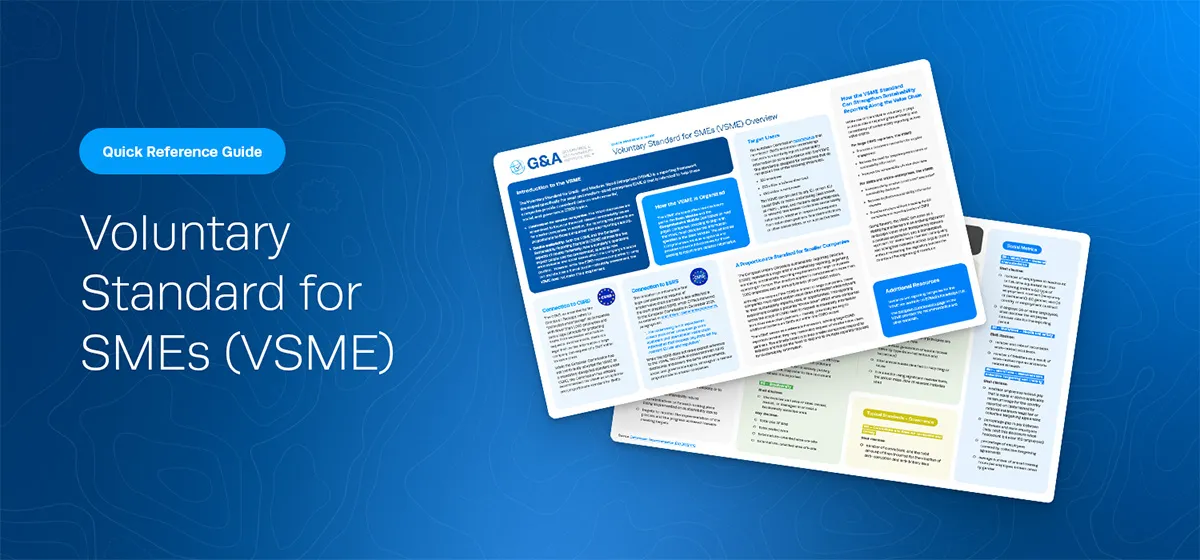
G&A’s VSME Quick Reference Guide outlines the VSME’s purpose, structure, and disclosure requirements under both the Basic and Comprehensive Modules. The guide also explains how the VSME fits into the wider EU regulatory context, including its connections to CSRD, ESRS, and the Omnibus I amendments.
For support assessing your organization’s CSRD and ESRS readiness, reach out to G&A’s team of sustainability and climate analysts.
 ABOUT CHRISTINA CARLTON
Senior Sustainability & Climate Analyst, G&A Institute
Christina Carlton is a Senior Sustainability & Climate Analyst at Governance & Accountability Institute. She supports both sustainability and climate engagements, and her work bridges sustainability planning and reporting with targeted climate initiatives, helping companies enhance their ESG performance and integrate resilience into their overall sustainability frameworks.