 Return to blog

Key Highlights
- EPR (Extended Producer Responsibility) laws are now a legal reality in the U.S., moving beyond circular economy dialogue into regulation with growing corporate impact.
- EPR packaging laws require companies to assess covered producer status, packaging types, and state‑by‑state thresholds to determine compliance obligations.
- Covered producers must register with Producer Responsibility Organizations (PROs) like the Circular Action Alliance and report packaging quantities to meet state deadlines.
Within the United States, the term “EPR,” which stands for Extended Producer Responsibility, has moved beyond circular economy discussions and is increasingly becoming a legal reality for many companies. As more states enact EPR legislation, a growing number of companies are finding themselves subject to a new wave of laws—those specifically targeting product packaging.
At G&A, we hear many U.S.-based companies asking what EPR is, what their packaging EPR obligations may be, and how to prepare for EPR laws for packaging and paper.
What is EPR?
Extended Producer Responsibility (EPR) is a regulatory strategy to hold companies accountable for managing the end-of-life phase of their products and packaging. EPR laws shift the financial responsibility for handling discarded products and packaging waste from municipalities to the companies that produced them.
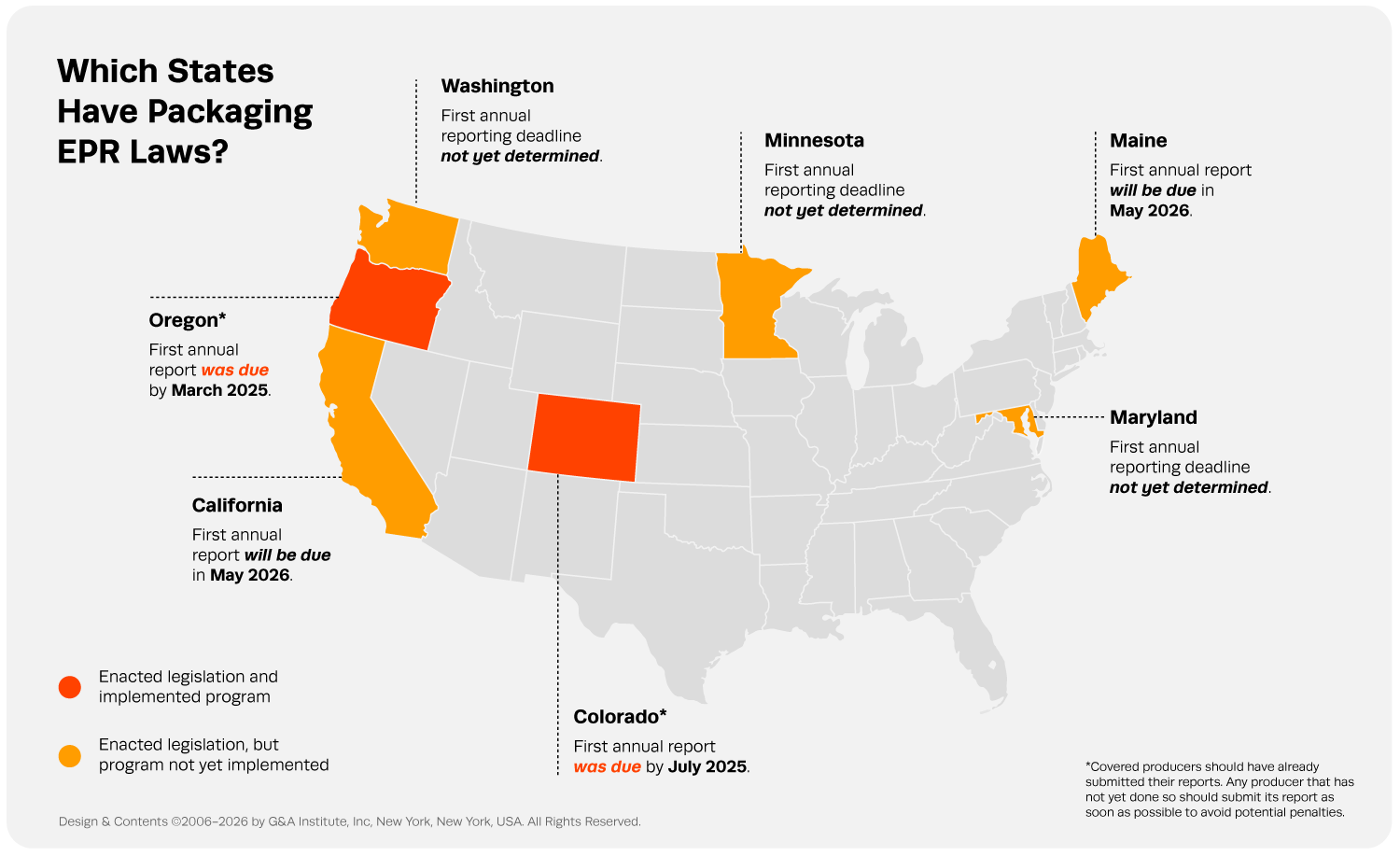
As of early 2026, 35 U.S. states have enacted EPR laws, for a total of more than 145 such regulations in effect today. The laws cover over 20 product categories. Until recently, the laws covered products like electronics, batteries, and paint, but now they have expanded to include packaging materials. EPR regulations for packaging materials have been enacted in seven U.S. states and proposed in approximately 14 additional states, with two proposals introduced as recently as 2026.
Deadlines to report in accordance with packaging EPR laws have already passed in several states, and others are rapidly approaching. Companies should take action now to ensure compliance with these laws.
Determining Your Company’s Packaging EPR Obligations
Four key factors must be evaluated to determine whether a company is subject to EPR requirements for packaging:
- whether the company meets the definition of a covered producer
- whether any producer exclusions are available
- whether the company’s packaging materials and paper products are considered covered products
- whether any product exclusions apply
The specific definitions of these terms vary by state, as do the thresholds for applying them, but they are the general criteria that determine a company’s exposure to packaging EPR laws.
How to Register as a Producer, and What to Report
In each state, covered producers are expected to register with a Producer Responsibility Organization (PRO), which is a non-profit intermediary between producers and state regulators. In the U.S., the Circular Action Alliance (CAA) is currently the only approved PRO for EPR laws. Producers with EPR for packaging obligations must register on CAA’s website and submit their reports in CAA’s data collection portal in accordance with the state-specific deadlines listed in the graphic above.
Covered producers are expected to submit reports on the quantities of covered materials supplied into each applicable state. The quantities reported will determine the fees owed.
Many states allow small businesses that fall below certain revenue or material tonnage thresholds to pay a flat fee, while larger producers are expected to pay fees based on the quantity and type of packaging they introduce into the market.

How to Prepare for Packaging EPR Laws
Companies that have not yet assessed their EPR exposure should start by determining whether they are a covered producer, and if so, conducting a scoping exercise that determines which of their packaging materials are subject to EPR laws in each state. Registration with the appropriate PRO, and reporting of data to the PRO, must occur as soon as possible for those states where deadlines have passed. With other state deadlines approaching quickly, now is the time to take the necessary compliance actions.

How G&A Can Help
Through our careful scoping analysis, the team at G&A Institute reviews companies’ packaging materials to identify those that are subject to packaging EPR laws in each of the seven states with enacted legislation. We then provide guidance on PRO registration and reporting, how to estimate EPR fees, and how best to position the company for future compliance and fee reduction. Set up a call to learn more about how we can help your company navigate EPR regulations for packaging.



Share This Article

 How Can G&A Help?
Build your sustainability strategy.
Chat with our experts to get started on your journey.
Get Started
