



This website uses cookies so that we can provide you with the best user experience possible. Cookie information is stored in your browser and performs functions such as recognising you when you return to our website and helping our team to understand which sections of the website you find most interesting and useful.
Supply Chain Technologies Help Improve Sustainable Operations and Reporting
Posted on March 10, 2026 by Sheccid Rodriguez
#Climate Change #Corporate CSR Reporting #Corporate Responsibility #ESG Issues #Supply Chain #Sustainable & Responsible Investing
By Sheccid Rodriguez, Sustainability Analyst Intern, G&A Institute
In recent years, a need has grown for companies to improve supply chain operations and traceability in an effort to reduce their greenhouse gas emissions, in recognition that corporate supply chain emissions (Scope 3) are on average 26 times greater than operational emissions, as found by CDP. In addition, evolving stakeholder expectations and expanding regulations, including ESRS and California SB 253, have made the issue of sustainability reporting more salient due the related risk of fines and other impacts for non-compliance.
An ongoing digital transformation that includes various technologies and artificial intelligence is aiming to address sustainable operations and reporting pressures by providing solutions to the growing need for data collection, better reporting systems, and reliable information verification.
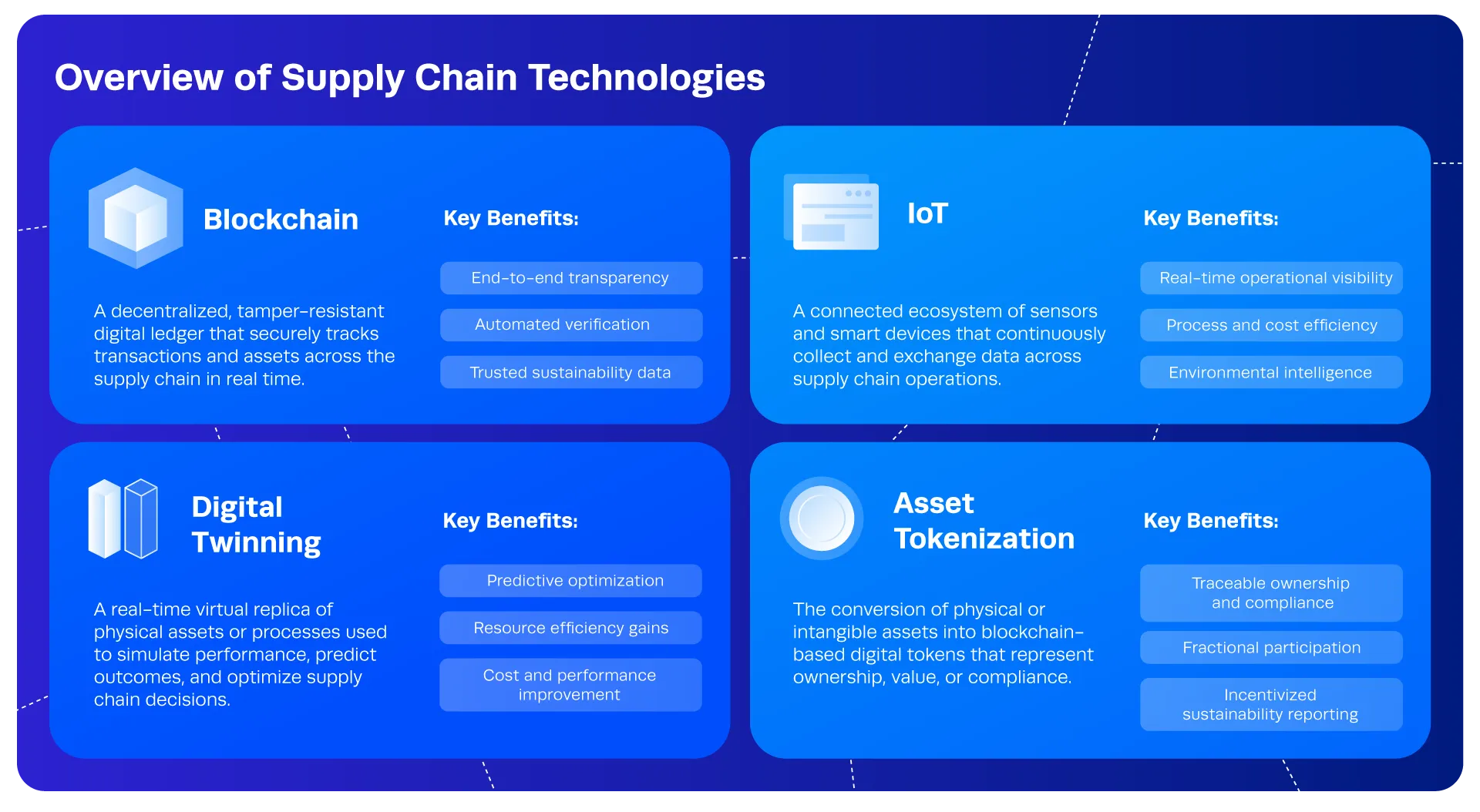
Blockchain, digital twinning, internet of things (IoT) devices, and asset tokenization represent some of these technologies that can support organizations’ decision making to identify areas to reduce emissions and develop reliable sustainability reporting.
Blockchain
Blockchain technology is a decentralized digital ledger that can quickly and easily track assets and record transactionsthroughout the supply chain. This system allows for real time reporting of information by suppliers that is accessible to others, removing the time-consuming need of manual tracking or involving third parties. With the information being accessible to all stakeholders it also provides increased transparency and helps address supply chain risks.
Blockchain has the potential to revolutionize sustainability reporting with its ability to consistently update records, which will make accessing sustainability data automatic and widely available across organizations. The technology is alsotamper-resistant, which makes fraud and retroactive editing difficult, and improves overall verification.
Digital Twinning
Digital twinning or digital twins refer to a virtual, real-time representation of a physical asset or process. They are used to predict how changes may impact their real counterpart to quickly detect problems, design better products, and realize benefits. The predictive capabilities of digital twins has the ability to forecast demand fluctuations and aid with procurement decisions, especially of raw materials, within supply chains to improve resource efficiency. By 2027, it is estimated that 40% of large companies will be using this technology to increase revenue.
Organizations have already utilized digital twins to identify large opportunities to reduce emissions. For example, an LG Electronics factory implemented this technology and reports that it was able to reduce its energy consumption by 30%. Schneider Electric has utilized digital twins during plant installations and used the data to optimize energy management by 25%, minimize material waste by 17%, and reduce carbon dioxide emissions by 25%. These examples demonstrate the supply chain efficiencies and cost-effectiveness that digital twins can provide an organization in a way that can help achieve sustainability reporting goals.
IoT
IoT is a connected network of internet-enabled devices and software, including physical objects like sensors and smart tags, that communicate to collect and exchange data to drive solutions. The system can be integrated into various parts of a supply chain to provide timely insights where manual data collection is either difficult or not possible. The technology offers continuous data collection that can help reduce costs and improve process management. It is estimated that industrial applications of IoT can add $14 trillion of economic value globally by 2030.
In relation to environmental impact, IoT can provide data on air and water quality along with energy management to allow for timely pollution intervention and the opportunity to reduce emissions. These data points are also valuable to help communicate sustainability metrics as reporting expectations expand. Furthermore, IoT can identify opportunities to support sustainability goals, with an analysis by the World Economic Forum showing that deployments can have positive impacts in the area of at least one target under the United Nations Sustainable Development Goals (SDGs) framework.
Asset Tokenization
Last, asset tokenization is the process of turning an asset into a digital token that can be managed within blockchain technology. This allows for the ownership of assets to be easily tracked in a digital form, especially when only fractions of an asset are owned by an individual.
Asset tokenization is often thought of in the context of finance but can have various sustainability applications. Tokens can represent compliance with environmental standards throughout supply chains, letting consumers verify sustainability practices and encouraging companies to continue sustainability efforts. Tokenization can even be applied to sustainability reports as a whole, giving small and medium-sized enterprises within supply chains the chance to negotiate with larger companies and provide sustainability data as paid information. This creates the incentive for early value chain actors to invest in sustainability actions and improve overall reporting.
Organizations can use these innovative technologies to advance sustainability, but they must also encourage collaboration across teams and systems while doing so. Teams will need to integrate new tools with existing systems and foster cross-department collaboration to realize the full benefits. Organizations must also prioritize strong data governance to ensure essential data management and oversight.
It is also important to note that while these supply chain technologies can offer the chance to identify opportunities for emission reduction and improve reporting, there are concerns about the additional energy consumption that is required. Organizations would have to evaluate the gains and costs that would be incurred if deciding to pursue the technological systems discussed above.
In short, blockchain, digital twinning, IoT, and asset tokenization represent available technologies that are aiding in making supply chains more transparent, efficient, and sustainable. With their use, companies will be better equipped to meet global sustainability expectations and make data-driven decisions that will support long-term resilience.
 ABOUT SHECCID RODRIGUEZ
Sustainability Analyst Intern, G&A Institute
Sheccid Rodriguez is currently pursuing a Master of Science in Environment and Sustainability Management at Georgetown University. She also recently graduated from Tulane University with a Bachelor of Arts in Political Science and Environmental Studies.