 Return to blog

Key Highlights
- The European Union’s draft simplified ESRS reduce disclosure requirements by about 60% while keeping core sustainability reporting priorities intact
- Simplified ESRS maintain double materiality as the foundational reporting principle, reinforcing relevance and decision‑usefulness
- ESRS are evolving into not just compliance requirements but strategic reference frameworks for sustainability risk and opportunity planning
As the European Union recalibrates its sustainability reporting regime, companies are reassessing what the European Sustainability Reporting Standards (ESRS) mean in practice. The draft simplified ESRS represent the latest phase in a broader global shift toward more regulated and standardized sustainability reporting. However, the revisions also signal a movement from an expansive compliance framework toward a more focused reference point for understanding regulatory expectations, materiality, and disclosure priorities.
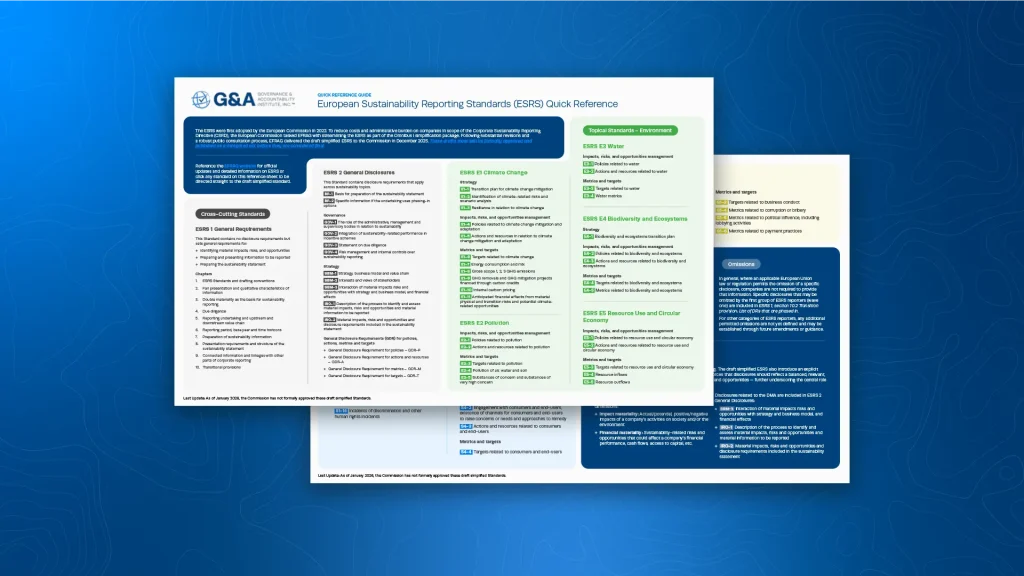
Against this backdrop, G&A recently updated its ESRS Quick Reference to reflect the revised standards. The guide is intended to help corporate sustainability teams apply the ESRS more practically, whether navigating the transition from the original standards or using the framework as a benchmark for internal reporting and preparedness.
As of early 2026, the European Commission is expected to approve the draft simplified ESRS through a delegated act, following review by the European Parliament and Council. While the final standards are still pending, the draft revisions offer insight into how ESRS reporting is evolving. Below are four key signals that companies should be monitoring as this evolution progresses.
Draft Simplified ESRS: Shifting from Expansion to Focus
While the revised standards will apply to a narrower population of companies under the Corporate Sustainability Reporting Directive (CSRD), they continue to signal how regulators expect sustainability information to be assessed, prioritized, and presented.
First adopted by the European Commission in 2023, the ESRS established a comprehensive framework for disclosing material environmental, social, and governance information. The standards were extensive, including over 1,000 datapoints, and they introduced new challenges and complexity to reporting companies.
In an effort to reduce the administrative burden for reporting companies, the European Commission in February 2025 directed EFRAG to revise the standards. In December 2025, EFRAG delivered to the Commission a set of draft streamlined standards that reduce disclosure requirements by about 60%. Although this is a significant reduction, EFRAG has endeavored to maintain the disclosure requirements deemed most critical for understanding a company’s sustainability-related impacts, risks, and opportunities.
As a result, we may see companies increasingly approach the ESRS not only as a compliance obligation, but as a reference framework to evaluate their responses to sustainability-related risks, benchmark themselves against peers, and identify areas of potential impact. This can be the case for companies, whether they remain within CSRD scope or are monitoring developments from outside it.
Double Materiality Remains the Foundation of ESRS Reporting
While the draft simplified ESRS are substantially revised, they do not alter the underlying logic behind ESRS reporting. Double materiality remains a foundational principle, and the simplified standards introduce an explicit reference to “fair presentation” as a core concept. Together, these requirements reinforce that sustainability disclosures are expected to provide balanced, relevant, and decision-useful information.
Rather than signaling a relaxation of requirements, this evolution sharpens the focus of ESRS reporting and places greater emphasis on the quality, relevance, and internal consistency of disclosed information.

Simplification Does Not Change the Underlying Principles
For companies still within scope of the CSRD, the simplified ESRS do not eliminate the need for robust preparation. Double materiality assessments, governance processes, and internal controls remain central to reporting, even as the volume of required disclosures has decreased. Organizations will still need to demonstrate how material impacts, risks, and opportunities have been identified, prioritized, and reflected consistently across strategy, governance, and risk management.
For companies no longer directly in scope, the ESRS continue to offer insight into regulatory expectations and emerging best practices. Investors, lenders, and other stakeholders increasingly reference ESRS concepts, particularly around materiality, when evaluating sustainability information. As a result, companies may begin using the ESRS as a benchmark to inform internal reporting frameworks and prepare for potential future requirements.
Using ESRS as a Planning Tool, Not Just a Compliance Exercise
The ESRS provide a structured framework for integrating sustainability considerations into broader business planning. By linking impacts, risks, and opportunities to strategy and the business model, the standards encourage companies to move beyond standalone sustainability narratives toward more coherent, decision-useful reporting.
The emphasis on double materiality and fair presentation reinforces the need for clear internal alignment across sustainability, finance, legal, and executive teams. When applied thoughtfully, the ESRS can support stronger governance, more consistent assumptions, and clearer connections between sustainability topics and financial performance.
In this way, the standards function not only as reporting requirements but as a tool for improving how organizations assess and communicate sustainability-related risks and opportunities.
A Practical Reference for Navigating ESRS Evolution
Against a backdrop of evolving standards and shifting scope, having a clear reference point matters. G&A’s ESRS Quick Reference supports companies as they navigate the transition from the original ESRS to the draft simplified standards. The guide provides a structured overview of the cross-cutting and topical standards, and places the simplified ESRS within the broader evolution of EU sustainability reporting under CSRD.
As ESRS requirements continue to move through the EU approval process, having a clear reference point can help organizations focus on what remains essential: applying double materiality rigorously and producing sustainability disclosures that are aligned, decision-useful, and fit for an increasingly regulated reporting environment.

Build your sustainability strategy.
Founded in 2006, Governance & Accountability Institute (G&A) is a New York–based sustainability consulting and research firm advising corporate leaders and investors at the intersection of strategy, governance, and regulation. For two decades, we have partnered with executive teams and boards to translate sustainability strategy into durable enterprise value — helping organizations navigate shifting market expectations, evolving policy landscapes, and increasing capital markets scrutiny. Set up a call to learn more about how we can help your company.



Share This Article

 How Can G&A Help?
Build your sustainability strategy.
Chat with our experts to get started on your journey.
Get Started
