 Return to blog

Key Highlights
- Major tech companies like Apple, Google, Microsoft, and Meta have set supplier deadlines between 2026 and 2030 to require renewable energy use and significant GHG emissions reductions.
- Suppliers who shift to clean energy don't just satisfy their largest customers; they have the chance to reduce emissions for all customers they serve.
- Companies that meet tech supplier sustainability requirements become part of a measurable global effort to limit warming to 1.5°C and improve air quality in local communities.
Thousands of companies support the tech industry, creating the collective potential to make real change.
This week, G&A launched a resource paper designed to help companies meet upcoming deadlines to decarbonize their operations for large tech customers. Putting the specific deadlines for four leading companies into one place, the paper outlines supplier requirements like:
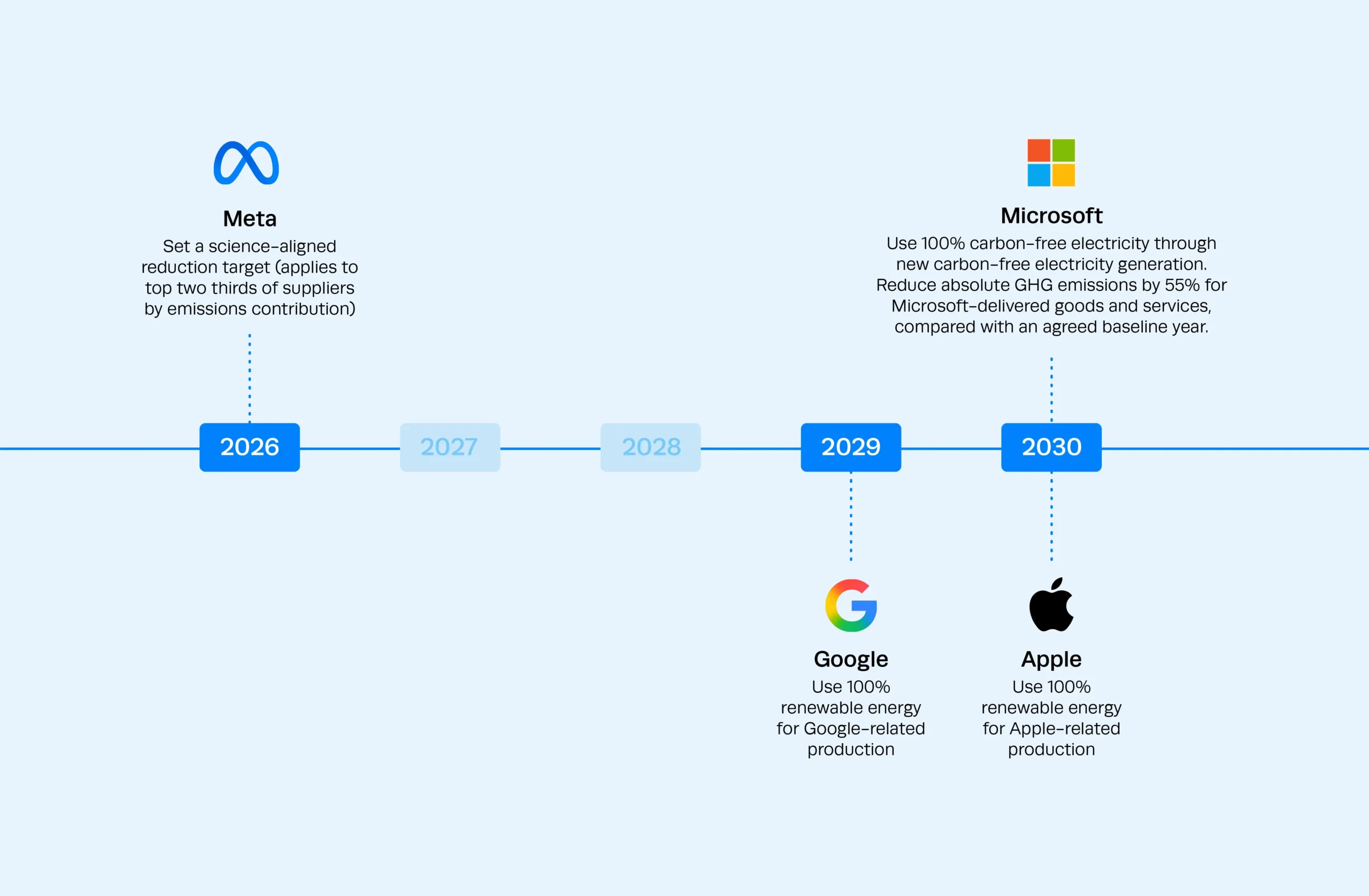
These milestones can seem daunting. To help companies navigate the complexity of responding to tech customers’ various climate and clean energy goals, the new paper offers a step-by-step roadmap, highlights common pitfalls to avoid, and details how G&A can help.
Beyond the immediate considerations involved in rising to ambitious customer demands, it’s also worth considering this: taking these actions can make a supplier part of a powerful movement for change.
Your Impact is Part of a Larger Collective Footprint
The category of greenhouse gas (GHG) emissions known as “Scope 3” covers emissions associated with a company’s value chain, such as those from suppliers and customers. These emissions go beyond the company’s own operations and are generally outside of its operational control.
But Scope 3 emissions have been in the spotlight as business’ greatest opportunity for decarbonization, given that they can comprise 70-90% of a company’s carbon footprint. The proportion is even higher in tech. Over 97% of Microsoft’s emissions lie in its vast supply chain.
If tech leaders’ supplier companies – starting with those that emit the most GHGs – change their energy sources in favor of lower emissions, the impact will reduce global GHG emissions in measurable ways.
As a group, Microsoft, Apple, Google, and Meta emit about 0.10% of global annual GHG emissions (2024 estimate), which is similar to a medium-sized country.
Your Carbon-Free Energy for Tech Leaders Improves Other Customers’ Impacts
Shifting their operations to cleaner energy and lower emissions doesn’t just bolster a supplier’s position with its biggest customers. It means other, smaller customers benefit from lower emissions, too. This is most effective if the GHG mitigation comes from new clean energy generation rather than the purchase of energy attribute certificates (EACs).
Microsoft has encoded this in its Supplier Code of Conduct, which requires that suppliers not only can claim 100% of carbon-free electricity for their MSFT operations by 2030, but that it leads to new and additional clean electricity generation at a local scale. In this way, MSFT aims to decarbonize the wider grid by displacing fossil fuels in the energy mix.
The Microsoft approach shows that if supplier programs are designed carefully, tech customers have a major opportunity to shift the energy powering entire industries. The size and economic influence of these companies magnifies their impact when they partner with suppliers to purchase and deploy more clean energy. By supporting initiatives such as helping fund the construction of new renewable energy infrastructure, large tech companies can reduce their own carbon footprint while also benefiting their suppliers.
Some large tech companies have launched programs to assist suppliers in making the transitions they require. These include Apple’s Supplier Clean Energy Program (CEP), Meta’s Net Zero Supplier Engagement Program, and Microsoft’s sustainability learning center and supplier eligibility for benefits through the Clean Energy Buyers’ Association.
By participating in large tech companies’ supplier programs, smaller companies may access tools and resources to enable decarbonization of their own operations and respective supply chains.

The Value of a Clean Grid – Global Climate Urgency
The UN Environment Programme’s 2025 Emissions Gap Report projects a 2.8 degree Celsius rise in global average temperature this century if governments continue with current policies, and a 2.3–2.5 degree rise if all current national pledges are met. By contrast, a maximum rise of 1.5 degrees is considered critical to avoid the most dangerous impacts of climate change.
Protecting that limit grows more ambitious with every passing year. To stay on a 1.5-degree pathway, global carbon dioxide (CO2) emissions need to fall by roughly 45% from 2010 levels by 2030, and reach net zero around 2050. Every company’s investment in decarbonization moves the world towards a safer climate and away from irretrievable environmental change.
A local view heightens the immediacy of a company’s GHG transition efforts. Reducing fossil fuel use directly reduces particulate matter in the air and lowers NO2 and SO2 pollution. For the surrounding communities, this means less smog, better respiratory health, and a thriving natural environment to support food, water, and quality of life.
Looking Ahead
Suppliers who take action to meet customer deadlines for clean energy and GHG reduction serve not only the Scope 3 efforts of their industry-leading customers. Beyond bolstering their position as a preferred supply partner, they advance a global effort to protect communities, clean our air, and mitigate climate change. The customer deadlines matter, but so does joining a powerful collective effort before it’s too late.

Build your sustainability strategy.
Founded in 2006, Governance & Accountability Institute (G&A) is a New York–based sustainability consulting and research firm advising corporate leaders and investors at the intersection of strategy, governance, and regulation. For two decades, we have partnered with executive teams and boards to translate sustainability strategy into durable enterprise value — helping organizations navigate shifting market expectations, evolving policy landscapes, and increasing capital markets scrutiny. Set up a call to learn more about how we can help your company.



Share This Article

 How Can G&A Help?
Build your sustainability strategy.
Chat with our experts to get started on your journey.
Get Started
