 Return to blog

Key Highlights
- The simplified ESRS and VSME standards are now officially published in the EU's Official Journal, marking their full and final adoption
- Companies may begin applying the revised ESRS starting with the 2027 reporting period; mandatory application begins in 2028
- The VSME gives small and medium-sized enterprises a voluntary and proportionate framework for reporting sustainability information
The path has been long, but this week the simplified European Sustainability Reporting Standards (ESRS) and the Voluntary Standard for Small and Medium-Sized Enterprises (VSME) were published in the Official Journal of the European Union (EU). This marks the finalization of these standards, which have been in various stages of development for several years. Below, we take a quick look at the evolution of each Standard and provide the essential takeaways companies need when aligning their reporting with either framework.
Need help navigating the standards? Our free quick reference guides make it simple:
ESRS Quick Reference (updated September 2026)
VSME Quick Reference (updated September 2026)
ESRS – Mandatory Compliance Under CSRD
Origin: In 2023, the European Commission first adopted the ESRS as the mandatory reporting standards for companies within scope of the Corporate Sustainability Reporting Directive (CSRD). The initial Standards were immense: they called for companies to review and potentially provide over 1,000 data points covering environmental, social, and governance topics; it also set an extensive, mandatory requirement to conduct a double materiality assessment in order to determine the specific disclosures on which to report.
Updates: In March 2025, the European Commission tasked the European Financial Reporting Advisory Group (EFRAG), the body responsible for developing the ESRS, with streamlining the Standards in accordance with the Omnibus I simplification package, which aimed to reduce the reporting burden on companies. Following substantial revisions and a robust public consultation process, EFRAG delivered draft simplified Standards to the Commission in December 2025. The Commission officially adopted the simplified ESRS in July 2026. The Standards became official on September 21, 2026 when they were published in the Official Journal of the EU as a delegated act under CSRD.
Impact: The finalization of the ESRS amounts to a significant shift in the EU’s approach to mandatory sustainability reporting. The final number of mandatory datapoints has been reduced by over 60% from the initial set of Standards, and the changes are expected to reduce reporting costs by 30% for each reporting company. Additionally, while the double materiality assessment remains the Standards’ foundation for sustainability reporting, its updated process allows companies more flexibility in determining which sustainability topics are material to their operations.
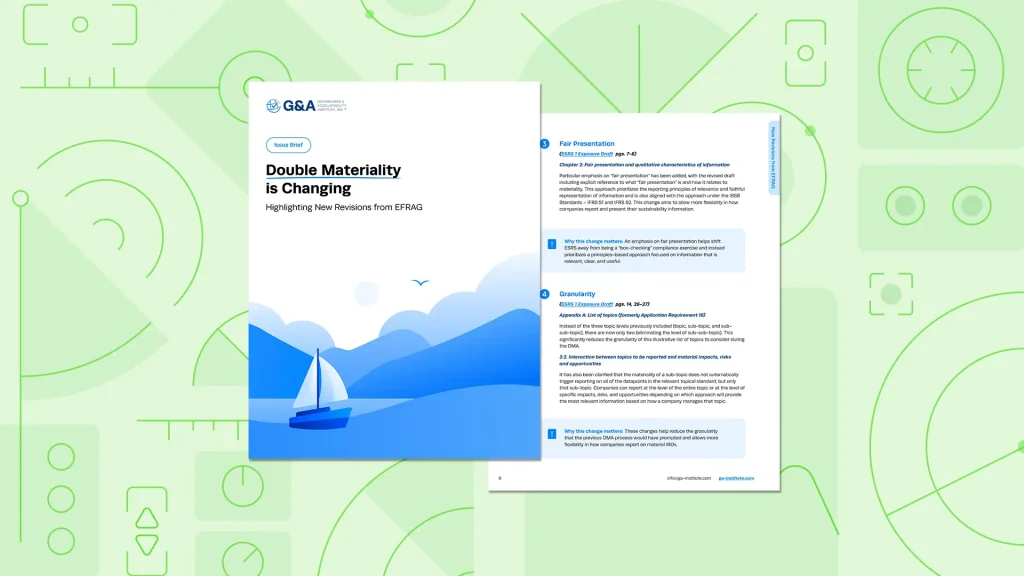
Top Line Takeaways: What’s New, What’s Not
- The simplified ESRS are finalized, and companies can voluntarily implement these Standards beginning in the 2027 reporting period (reports covering 2026 information); mandatory application begins in 2028 (reports covering 2027 information)
- A double materiality assessment is still a foundational and mandatory part of ESRS reporting
- EFRAG has developed a suite of online tools to help reporters navigate and apply the simplified Standards
VSME – A Voluntary Framework for Smaller Companies
Origin: In December 2024, EFRAG delivered the VSME to the European Commission, and in July 2025, the European Commission adopted the VSME as a recommended voluntary standard for SMEs.
Update: On September 21, 2026, the VSME became an official standard when it was published in the Official Journal of the EU as a delegated act under CSRD.
Impact: For mandated reporting under the CSRD, only large companies are in scope. However, these companies must report value chain information when relevant to their sustainability impacts, risks, or opportunities, creating a “trickle down” effect. As companies within the scope of CSRD need to request sustainability information from their value chain partners, reporting burdens can arise for small and medium-sized enterprises (SMEs) not within the CSRD scope. The VSME addresses this potential issue in two ways.
- For large CSRD reporters, the VSME:
- Serves as a reference framework, advising large CSRD reporters on what they may reasonably request of smaller value chain partners
- Promotes a consistent mechanism for supplier engagement
- Reduces the need for bespoke questionnaires on sustainability information
- Improves the comparability of value chain data
- For smaller companies across the value chain, the VSME:
- Increases clarity on what constitutes “reasonable” sustainability disclosure
- Reduces duplicative sustainability information requests
- Provides structure without imposing the full complexity and reporting burden of ESRS
Top Line Takeaways: Filling a Need on the Horizon
- The VSME has had a quieter development and rollout compared to the ESRS, but it fills an important gap in value chain sustainability reporting
- The Standard is voluntary and intended to be used by small- and medium-sized enterprises
Looking Ahead: Start Preparing Now
The past two years have been a whirlwind of sustainability standard development and revision in the EU. Companies have watched expectations and requirements frequently change, but with the finalization of the ESRS and VSME, the atmosphere seems to be calming.
Companies can confidently begin mapping datapoints against existing disclosures, revisit their double materiality assessment under the streamlined process, and start closing any data gaps. Although the standards have been simplified, comprehensive and traceable sustainability reporting still takes time, and that is work that can resume with renewed focus now that the requirements are finalized.

Build your sustainability strategy.
Navigating the requirements of the CSRD can be complex. G&A’s sustainability reporting experts can help your company assess where you stand and build a disclosure strategy that’s ready for what’s ahead. Need help aligning with the finalized simplified ESRS or applying the new VSME? Reach out to get started.



Share This Article

 How Can G&A Help?
Build your sustainability strategy.
Chat with our experts to get started on your journey.
Get Started
