 Return to blog
Key Highlights
- ESG data providers use different methodologies, scoring approaches, and definitions of materiality, which can result in different ratings for the same company.
- Major investor-facing ESG data providers include MSCI, Morningstar Sustainalytics, FTSE Russell, Bloomberg, LSEG, ISS STOXX, and S&P Global. Their data and scores help investors assess companies through different methodologies.
- Understanding ESG ratings and methodologies helps companies improve disclosures, strengthen ESG strategies, and better respond to stakeholder expectations.
Environmental, social, and governance (ESG) data informs how investors, lenders, and customers evaluate companies. But rather than analyzing each metric themselves, these stakeholders often rely on a third-party data rater to distill a firm’s data into decision-useful insights.
Raters use distinct methodologies, scoring systems, and definitions of materiality to identify and score each company’s ESG risks, management practices, and performance. For example, some focus on a company’s exposure to financially relevant ESG risks and how effectively those risks are managed. Others assess a company’s performance on environmental and social topics or disclosure quality alone. Most providers rely primarily on publicly available information, while some also incorporate company-submitted information through assessment questionnaires. As a result of these differences, one company can score high with some raters and low with others.
Although providers such as MSCI, Morningstar Sustainalytics, and ISS STOXX are widely recognized, their ratings are not always well understood.
In this article, we focus on seven investor-facing providers of ESG data and explain how each one produces ratings. The good news: despite their differences, most raters reward the same fundamentals, which we summarize at the end.
How to Engage with the Seven Major ESG Data Providers
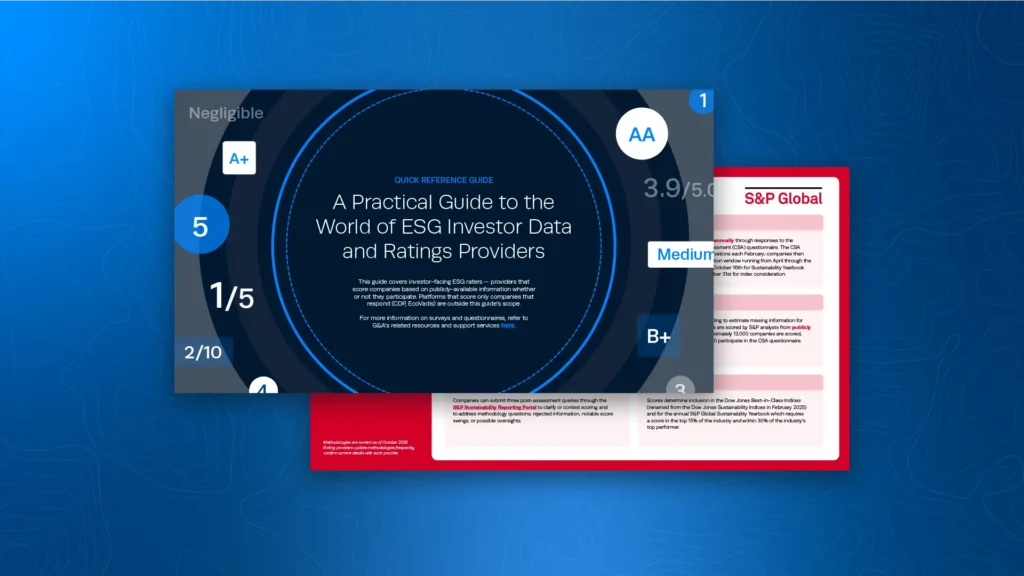
G&A recently launched its Practical Guide to the World of ESG Investor Data and Ratings Providers to introduce companies to ESG raters and rankers. This article provides recommendations for each data provider, so companies can focus limited resources where engagement matters most.
To learn more about each provider’s scoring, sources, timeline, and feedback opportunities, refer to the guide. MSCI ESG Ratings assess how well a company manages sustainability risks and opportunities relative to its peers. MSCI reports that its ESG Ratings cover more than 17,000 issuers and 999,000 securities worldwide.
MSCI assigns “Key Issues” to each company based on a financial materiality lens. Most Key Issues depend on the industry and business model because the most relevant risks vary considerably across sectors. Only the issues of Corporate Governance and Corporate Behavior are assessed across all companies. For each applicable Key Issue, MSCI considers the company’s exposure to risks and opportunities and how effectively they are managed. These roll up to a final rating, ranging from CCC (lowest) to AAA (highest), and are assigned relative to industry peers facing similar risks.
To inform its ratings, MSCI draws on corporate disclosures, regulatory filings, media reports, NGO research, and other alternative data sources. Rated companies can review information and provide feedback year-round through MSCI’s online issuer portal on MSCI ONE. Under MSCI’s current methodology, companies are monitored on an ongoing basis, and letter rating changes are triggered when pre-defined criteria are met rather than on a fixed annual schedule.
Investors use MSCI ratings in research, portfolio construction, and engagement. They inform certain MSCI ESG indexes and other third-party recognitions, such as the TIME Magazine / Statista list of the World’s Most Sustainable Companies.
G&A’s Recommendations for Companies
Companies should begin by understanding the Key Issues that MSCI has assigned to their industry. Then they can confirm that their public disclosures clearly tie to risk exposure, governance, policies, management systems, targets, and performance that are being evaluated. If their existing disclosures do not do so, they can clarify them or publish additional information, as appropriate.
We also recommend reviewing the MSCI issuer portal regularly to identify inaccurate, incomplete, or outdated information.
 The Morningstar Sustainalytics ESG Risk Rating also identifies the most financially relevant issues for each company, but unlike MSCI’s industry-relative letter rating, the Sustainalytics score is designed as an absolute measure of risk, to support comparisons across companies and industries. Its analyst-assessed research universe covers more than 16,000 companies across the public equity, fixed income, and private sectors.
Sustainalytics assigns each company Material ESG Issues using a financial materiality lens, then evaluates the company’s exposure to associated risks and how effectively the company addresses them through policies, programs, practices, and performance.
The final ESG Risk Rating reflects the material ESG risk that remains unmanaged, including inherently unmanageable risks, gaps in management, and relevant controversies. Scores start at zero on an open-ended scale, with lower scores indicating less unmanaged ESG risk. In practice, roughly 95% of companies score below 50, and scores of 40 or above are classified as “severe.”
Sustainalytics uses public information from corporate reports, company websites, news coverage, and NGO research. Companies can review their assessments, submit supporting public documentation, and make factual corrections through the online Issuer Gateway or by emailing the Issuer Relations team. Reviews occur annually, with timing that varies bycompany. Certain indicators and controversies may be updated between full assessments.
G&A’s Recommendations for Companies
Prior to the annual Sustainalytics review, companies should confirm that their industry classification is accurate, review the applicable Material ESG Issues and management indicators, and ensure that relevant public information is up to date and accessible. After Sustainalytics’ assessment, we recommend using the data validation period to identify factual errors or overlooked public evidence that can be shared to fill gaps.
 FTSE Russell ESG Scores assess companies’ exposure to, management of, and performance on relevant ESG issues, similar to MSCI and Sustainalytics, but with a difference in approach: FTSE Russell reports both an absolute ESG Score from 0 to 5 and rankings relative to industry peers.
FTSE Russell is part of LSEG, but its ESG Scores are a separate product from the LSEG ESG Scores covered below. The scoring methodology uses over 300 indicators organized across three pillars and 14 themes, applied depending on factors such as a company’s industry, business activities, geographic presence, and level of exposure to each issue.
FTSE Russell’s peer rankings compare companies within the same Industry Classification Benchmark (ICB) Supersector, with pillar rankings reported in deciles and the overall ESG ranking reported as a percentile.
FTSE Russell bases its assessment on publicly available information, including company reports, policies, webpages, and other public sources. Assessed companies can review their scores and underlying data through the Sustainable Investment Data online portal and provide feedback during the annual review period.
FTSE Russell ESG Scores also help determine a company’s eligibility for inclusion in the FTSE4Good Index Series, alongside other eligibility requirements. The evaluation cycle generally runs from June through the following March, with two waves of results. Companies whose annual ESG disclosures are published between April and September are typically reviewed for the December index review, while disclosures published between October and March generally inform the June review.
G&A’s Recommendations for Companies
Companies should ensure that disclosures addressing FTSE’s most relevant ESG themes are clear, specific, accessible, and published before the applicable cutoff date. They should then use the review period to flag factual errors or overlooked public information.
 Bloomberg provides ESG data and scores that assess how companies manage financially material, industry-specific sustainability risks and opportunities, using public company disclosures. Its ESG Scores cover more than 15,000 companies globally and are used in investment research and corporate investor relations. A company can review how its score appears to investors through the Bloomberg Corporate Web portal.
Bloomberg’s scores cover financially material environmental and social issues specific to each industry, along with governance policies and practices adjusted for country-specific rules and regulations. Companies are compared within peer groups defined by Bloomberg’s ESG Classification System (BECS), which groups companies with similar business models, products, supply chains, and risks. Because the scores are model driven rather than based on analyst opinion, they can be updated monthly as companies release new data. Disclosure itself also counts: the methodology treats the reporting of quantitative data as a dimension of performance.
G&A’s Recommendations for Companies
Companies should review their score and the underlying data, check for missing or outdated disclosures, and make relevant public information easy to locate. If Bloomberg’s underlying data is inaccurate or incomplete, companies should submit feedback through the Corporate Web portal, providing supporting public references where appropriate.

 LSEG provides ESG data and scores to assess how companies manage material ESG risks and opportunities across ESG themes. Its data and scores are used in investment analysis and other financial workflows. LSEG covers more than 16,000 companies globally, including 99% of the FTSE All World Index. In addition to ESG Scores, LSEG offers ESG Scores Plus, which adds selected risk and impact measures.
Through LSEG’s ESG Contributor Tool, companies can submit ESG data for the current year, edit historical data LSEG already holds, and view their own scores for the current and prior two periods alongside the scores of industry peers. Submissions are verified by LSEG before they appear in its investor products, such as LSEG Workspace. LSEG recently launched its new Sustainability Ratings and Data, with its previous ESG Scores moving to legacy status after a transition period.
G&A’s Recommendations for Companies
Companies should review the data LSEG holds for them, correct inaccuracies, and ensure their published disclosures clearly reflect their ESG-related policies, actions, and performance.
 ISS STOXX is the source of three types of scoring and rating relevant for ESG investors. First, the ISS STOXX Governance QualityScore focuses on corporate governance, and investors may use it to support risk analysis, engagement, policy development, and proxy-voting decisions.
The rating process evaluates governance practices and related risk across four categories: board structure, shareholder rights, compensation, and audit and risk oversight. Companies receive an overall score from 1 to 10, along with category-level scores relative to the applicable market or regional comparison group. A score of 1 generally indicates higher-quality governance practices and lower relative governance risk, while a score of 10 indicates lower-quality practices and higher relative risk.
The second type of score from ISS STOXX is the Environmental & Social (E&S) Disclosure QualityScore. It identifies disclosure strengths, omissions, and potential areas of environmental and social risk relative to industry peers, but it does not represent a direct measure of the company’s performance on environmental or social issues.
Governance QualityScore and E&S Disclosure QualityScore cover publicly traded companies across major global markets, with separate coverage universes and comparison groups determined by ISS STOXX. Both products rely primarily on public filings, corporate reports, policies, and other company disclosures. Covered companies can review the underlying data and submit corrections or feedback year-round through ISS’s online Data Verification tool on the ISS-Corporate Compass platform, except during applicable blackout periods.
Finally, the ISS STOXX Corporate Rating evaluates a company’s sustainability risks, opportunities, and real-world impacts across its value chain. The methodology considers both how sustainability issues may affect the company and how the company’s activities may affect people, society, and the environment. Its global coverage includes publicly listed and non-listed companies, encompassing approximately 8,600 companies.
Companies receive a performance rating on a 12-point scale ranging from A+ to D-. Those that meet or exceed the performance threshold established for their industry receive Prime status, indicating that they satisfy ISS STOXX’s defined absolute performance requirements.
The assessment draws primarily on publicly available corporate reporting and other relevant sources and is supported by analyst review. The Corporate Rating now also incorporates data from the Governance QualityScore. Ratings are reviewed annually and may also be updated in response to significant events or new information.
G&A’s Recommendations for Companies
Companies should use the data verification process to confirm that ISS has captured their public information accurately. Improving Governance QualityScores generally requires reviewing each category’s practices and risk indicators with an investor relations expert. For E&S Disclosure QualityScore, companies should focus on making relevant environmental and social information complete, specific, consistent, and accessible. Because the Corporate Rating considers both financial relevance and broader impacts, companies should review how they manage and report sustainability risks and opportunities as well as their impacts across operations, products, services, and the value chain. Relevant disclosures should demonstrate clear governance, policies, due diligence processes, implementation, and measurable performance.
 S&P Global produces two related sustainability scores through its Corporate Sustainability Assessment (CSA): the CSA Score and the ESG Score. The assessment uses 62 industry-specific questionnaires designed around the sustainability topics considered most relevant to each industry.
Companies can choose to proactively shape their scores by completing the CSA questionnaire and providing supporting evidence through S&P Global’s online Sustainability Reporting Portal. Depending on the question, evidence may include public information or confidential internal documentation. Companies that do not participate in the CSA questionnaire are scored by S&P analysts based on publicly available disclosures. Of the approximately 13,000 companies scored, about 3,500 participate in the questionnaire each year.
S&P also incorporates its own findings, such as controversies surfaced from a Media and Stakeholder Analysis, as they may indicate weaknesses in a company’s management systems or performance.
The S&P Global ESG Score uses the same underlying CSA assessment but incorporates modeling for certain information gaps. The CSA Score excludes modeling, and questions with missing disclosure receive zero. Modeling is not applied to questions that require public disclosure. Both scores assess performance relative to companies in the same industry and should not be compared across industries. Scores range from 0 to 100, with an industry percentile ranking. The scores measure a company’s performance on and management of sustainability risks, opportunities, and impacts that S&P considers material, relative to industry peers.
The CSA runs annually. Companies can select a two-month participation window starting between April and November, and scores are released on a rolling basis, typically beginning in July.
CSA results support company benchmarking and may also inform eligibility for inclusion in the S&P Global Sustainability Yearbook, the Dow Jones Best-in-Class Indices, and certain S&P Scored & Screened Indices. However, each recognition program or index applies its own eligibility requirements, cutoff dates, and selection process.
G&A’s Recommendations for Companies
Companies should review the industry methodology and scoring weights before their participation window, assign clear internal data owners, and establish a consistent process for collecting and validating evidence. Active participation allows a company to provide more complete and current information, while non-participating companies are assessed without direct questionnaire responses.
For more information about the CSA, read G&A’s Unlocking the Strategic Power of the Corporate Sustainability Assessment (CSA) and Take the Pressure Off During Submission Season: Tips for Preparing and Responding to the Corporate Sustainability Assessment (CSA).
Where Companies Should Focus
To prioritize effort among the various ESG data providers, companies should determine which assessments their key investors and other stakeholders use, as well as whether the results influence indices, benchmarking, or recognition programs that are especially relevant for them.
For example, MSCI, Morningstar Sustainalytics, and FTSE Russell should take precedence when a company’s investors or asset managers use them, or when ESG index inclusion is a priority. Bloomberg and LSEG may warrant attention when investors use their ESG data and scores in research and analysis. ISS STOXX may need to be prioritized when investors use its governance scores, environmental and social disclosure assessments, or broader Corporate Rating. The S&P Global CSA may be especially relevant for companies seeking detailed industry benchmarking, as well as for those pursuing inclusion in the S&P Global Sustainability Yearbook, the Dow Jones Best-in-Class Indices, or certain S&P Scored & Screened Indices.
Our Recommendation
The major rater assessments differ in their approach, but they tend to evaluate common themes that are considered important for a company’s stability and positive impact. While each company’s efforts should reflect its unique sustainability strategy, companies will be well-positioned across many raters if they develop and enhance programs and disclosures in line with these themes:
- Industry-specific sustainability risks and opportunities
- Board and executive oversight
- Climate-related risk and environmental management
- Human capital, health and safety, and human rights
- Business ethics, compliance, and risk management
- Supply chain and customer-related issues
- Targets, performance metrics, and evidence of implementation
- Data quality and transparent public disclosure
We encourage companies to approach ESG data disclosure as a holistic strategy. This has deeper benefits than approaching each rating as an entirely separate exercise or attempting to improve a specific score in isolation. Strong governance, effective programs, reliable data, and clear disclosure provide a more durable foundation and can improve how the company is represented across multiple assessments – while also bolstering its resilience and social impacts.

How G&A Can Help
G&A’s ESG Data Review provides companies with a clear view of how they are assessed by major ESG data providers and where improvements can have the greatest impact. First, G&A cross-references public disclosures with provider datasets to identify inaccuracies, missed data points, and disclosure gaps. Then, G&A maps ESG data across raters to identify top-priority actions based on materiality, potential impact, and return on investment. This helps companies identify disclosures and other actions that may improve multiple ratings at once. The result is a topic-based, impact-weighted action plan designed to strengthen data quality, collection, management, and investor-facing disclosures.
G&A can also engage directly with ESG data providers to correct errors, submit updated information, validate data accuracy, and track resulting score changes. While individual providers ultimately determine each score, this coordinated approach helps companies focus their resources on the improvements most likely to strengthen their overall ESG ratings profile.
Talk to our experts to learn more about the services we offer related to ESG data ratings. For additional information, explore our Practical Guide to the World of ESG Investor Data and Ratings Providers.



Share This Article

 How Can G&A Help?
Build your sustainability strategy.
Chat with our experts to get started on your journey.
Get Started