 Return to blog

Environmental, social, and governance (ESG) issues can have material impacts and pose business risks, but they have historically been hard to quantify. A new ESG framework – the Task Force on Inequality and Social-related Financial Disclosures (TISFD) – will offer a way for companies to measure and disclose social measures in a standardized, investor-useful way.
Just as the Task Force on Climate-related Financial Disclosures (TCFD) and the Task Force on Nature-related Financial Disclosures (TNFD) developed frameworks with recommendations on how companies should assess and report material financial information on subjects (climate, nature) that previously lacked clear guidance on quantifiable measures, the Task Force on Inequality and Social-related Financial Disclosures (TISFD) developed a framework to fill a long-standing gap in guidance on how to quantify the financial risks of social issues.
TISFD entered the sustainability disclosure landscape in 2026, releasing the first draft of its framework, Beta Version 0.1, in May. The framework is being refined through public consultation, additional drafting, and pilot testing, and a final version is expected by late 2027.
Here is what companies need to know.
What is the TISFD?
The Task Force on Inequality and Social-related Financial Disclosures (TISFD) is a global, multi-stakeholder group that has prepared a draft of a globally applicable framework to help businesses and financial institutions identify, assess, and report on their impacts, dependencies, risks, and opportunities related to social issues in their operations and value chain, including:
- Human rights
- Labor rights
- Community well-being
- Inequality
- Access to economic opportunity
The recommendations of the TISFD follow the same four-pillar structure as the TCFD and TNFD: governance, strategy, risk management, and metrics and targets.
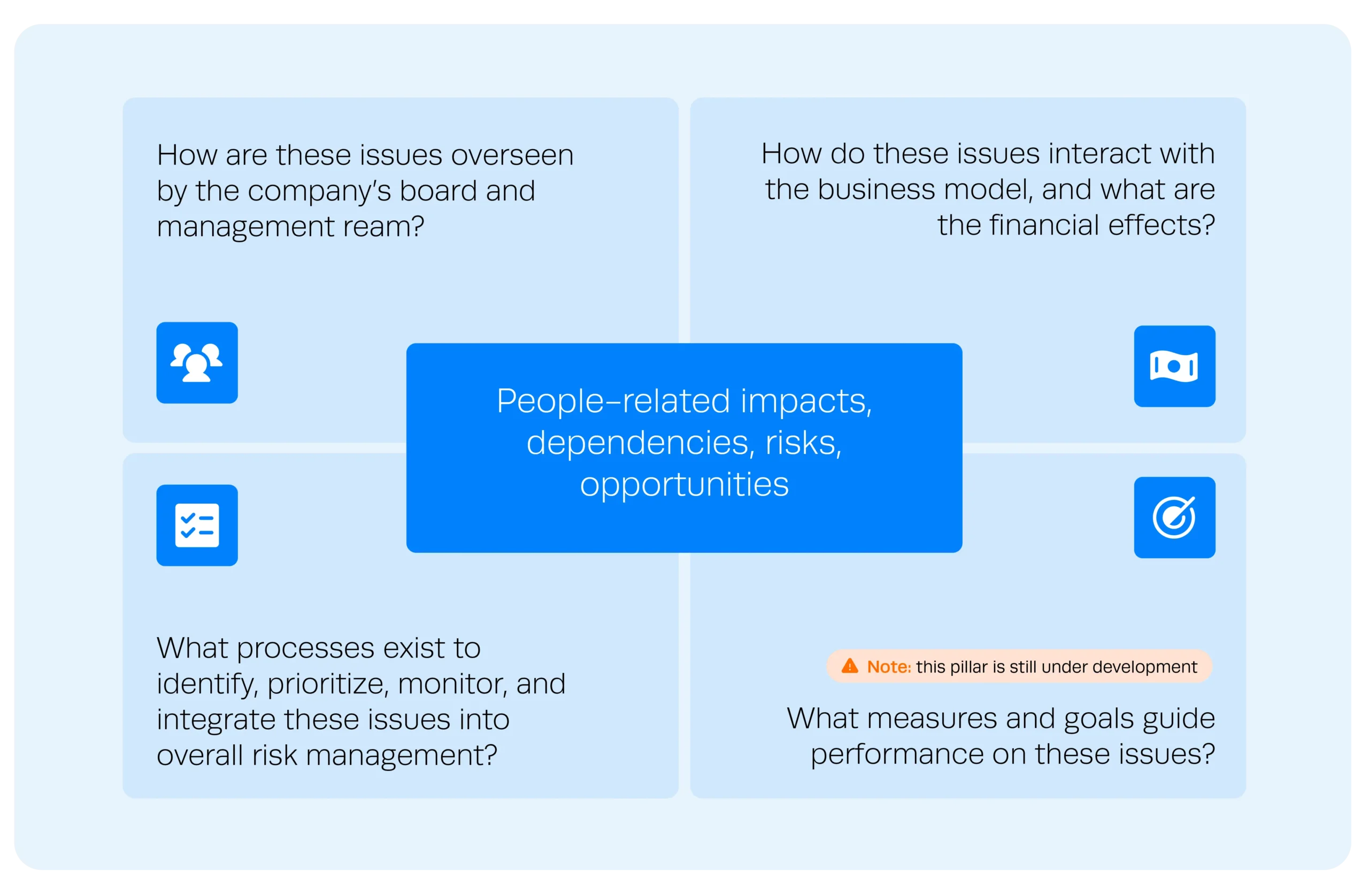
Five requirements establish the general expectations for TISFD disclosures:
- Materiality – Organizations reporting in line with TISFD should disclose material information about their impacts, dependencies, risks, and opportunities.
- System-relevant information – Disclosures should meet investors’ information requests for people-related externalities related to risks.
- Stakeholder engagement – Organizations should describe how they’ve engaged with stakeholders.
- Scope – Organizations should explain the scope of their assessment and disclosures and how it was determined.
- Time horizons – Organizations should consider and define short-, medium-, and long-term time horizons.
Why was it created?
The TISFD primarily aims to support disclosure around the topic of people. However, recognizing the interconnectedness between people, climate, and nature, it also aims to support integrated disclosure around all three of these topics by providing a similar four-pillar structure to each set of recommendations. The TISFD understands that climate- and nature-related issues can affect people, and conversely, that people-related issues can affect strategies aimed at minimizing negative effects on climate and nature. The intent is that organizations can eventually report across all three taskforce frameworks by disclosing their governance, strategies, risk management, and metrics and targets related to people, climate, and nature.
Who is it for?
TISFD is a voluntary framework, designed for use by businesses and financial institutions across sectors and industries.
Organizations that may find TISFD recommendations useful include:
- Businesses and financial institutions – Any business or financial institution wanting to assess their risks and disclose people-related issues, whether driven by investor demand, competitive differentiation, or other motivations.
- Regulators, policymakers, civil society, and labor organizations – Entities seeking to understand and compare how organizations manage people-related issues.
- Multinational enterprises with complex, global value chains – Organizations with labor practices and community impacts already under scrutiny, which could use TISFD to internally assess and minimize risks.
- Organizations already navigating human rights due diligence obligations – Those preparing for disclosure in line with existing or forthcoming legislation, such as the EU’s Corporate Sustainability Due Diligence Directive, which could apply the guidance in TISFD’s framework to measure human rights impacts and disclose their human rights due diligence.
What is the TISFD’s current status?
The latest version of the framework, which is still in draft form, includes conceptual foundations and recommendations across governance, strategy, and impact and risk management. It does not yet include metrics and targets, detailed implementation guidance, or scenario analysis guidance.
The development roadmap runs as follows:
| Milestone | Timing |
| Framework Beta v0.1 (current) | Mid-2026 |
| Framework Beta v0.2 | Late 2026 |
| Framework Beta v0.3 | Mid-2027 |
| Final TISFD Framework | Late 2027 |
The public consultation on v0.1 closes July 31, 2026. This is an opportunity for the public to shape the framework’s final direction, particularly on areas still under development, including materiality approaches, metrics, scenario analysis guidance, and the treatment of system-level risks.

How G&A can help
The TISFD is still a work in progress, but it is evident that social and inequality-related issues are an increasingly important topic in companies’ disclosures.
To discuss how G&A can support your alignment with the TISFD through a gap analysis, integrating your ESG disclosures with other frameworks such TCFD and TNFD, contact us today.



Share This Article

 How Can G&A Help?
Build your sustainability strategy.
Chat with our experts to get started on your journey.
Get Started
